
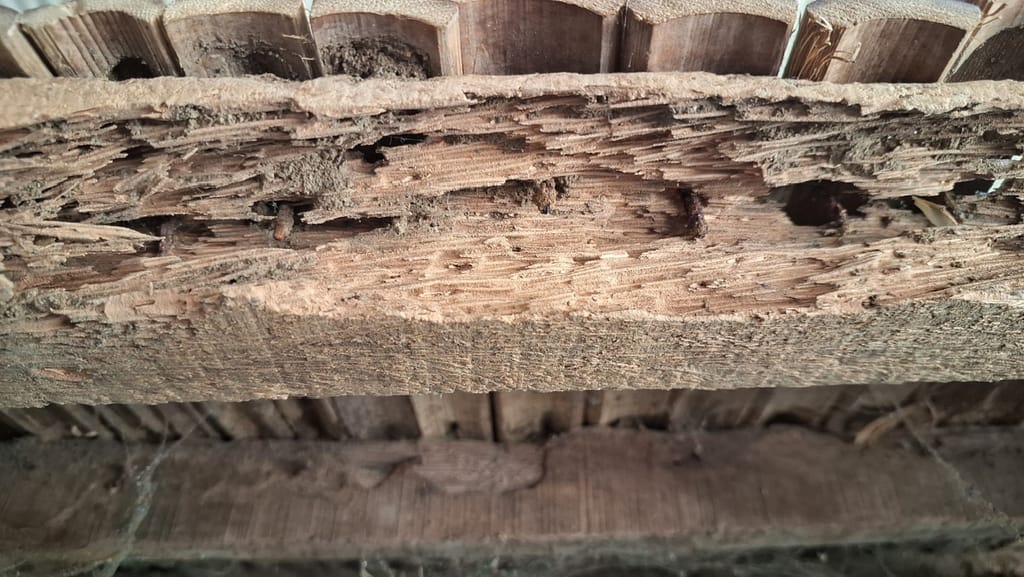
No, this isn’t a science fiction story. Two of the world’s most destructive termite species are now breeding with each other on U.S. soil
In a recent peer-reviewed study published in Proceedings of the Royal Society B by UF/IFAS, researchers confirmed established hybrid colonies in the wild. Jarrod Haneline, Client Success Manager at Pest Share, wants to spread the word. Property managers need to understand what they’re up against–potential structural damage and financial liability. Plus, these infestations are often nearly invisible until it’s too late.
Hybrid Termites Now Have Established Colonies
Two of the most destructive termite species in the world have been interbreeding–the Formosan subterranean termite and the Asian subterranean termite. Scientists suspected this was happening about a decade ago, when both species were observed swarming in the same time and place for the first time.
Hybrid swarms have now been confirmed every year since 2021, and were confirmed again in April 2025.
The first confirmed wild colony was only discovered in October 2024 in a Fort Lauderdale city park, despite likely being active for at least five years beforehand. Researchers now believe hundreds more established colonies already exist throughout the surrounding areas.
What Makes Hybrid Termites So Dangerous?
Both parent species are enough of a threat on their own.
Formosan colonies can contain millions of individual termites and forage far more aggressively than native species. Experts say the hybrid offspring are harder to control and reproduce faster than either parent species.
And there are some serious financial risks with these termites. Average termite damage per home typically runs between $40,000 and $60,000. Demolition is necessary in extreme cases.
If the hybrids are as adaptable to temperate climates as the Formosan species, it’s likely they’ll migrate beyond their current range.
Where Are These Termites?
Currently, the termites are confirmed in the Fort Lauderdale area, with the Asian subterranean termite already spreading as far north as Tampa, Melbourne, and other coastal areas.
Formosan termites are already established across the south, west coast, and Hawaii.
But, because Fort Lauderdale is a major boating hub, these termites have the potential to spread nationally and internationally–very quickly.
What Property Managers Need to Know
The single greatest threat for property managers isn’t the termites themselves, but how long these termites can go without being detected.
Subterranean termites are cryptic by nature. Most infestations are only discovered once the structural damage is already extensive.
Regular, professional inspections aren’t optional anymore. They are essential for financial protection. Jarrod Haneline, Client Success Manager at Pest Share, emphasizes that proactive monitoring and fast coordination between property managers and pest professionals is what separates a manageable situation from a costly one
Property managers should be asking their current pest control providers direct questions: Are you monitoring for subterranean termites? How often? What does your detection process look like?
Stay Ahead of What You Can’t See
The hybrid termite is now a real, confirmed threat. If researchers are right, it’s only a matter of time until it moves beyond its current range.
Leave a Reply